
For anyone considering an investment in HedgerX, one question deserves serious consideration before depositing money:
What happens if the platform suddenly stops operating?
Cryptocurrency investors sometimes focus heavily on advertised daily benefits, trading opportunities and token appreciation. However, the ability to recover funds if a platform experiences financial difficulties can be considerably more important.
A cryptocurrency exchange can suspend withdrawals, experience liquidity problems, suffer a security breach or become insolvent. An investment programme can also stop distributing benefits or cease operations altogether.
These are not merely theoretical risks. Several cryptocurrency businesses have experienced severe financial difficulties, leaving customers uncertain about whether they would recover their deposited assets.
HedgerX’s published terms and investment structure provide several important areas for examination.
This article explores what participants should understand about custody, withdrawal restrictions, corporate liabilities and potential recovery options.
1. Who actually controls the cryptocurrency deposited with HedgerX?
One of the most important disclosures appears in the official HedgerX Exchange Terms of Use, updated on 30 October 2025.
The document identifies HedgerX Exchange Malaysia Sdn. Bhd. as the legal party entering into the agreement with users of HedgerX.my.
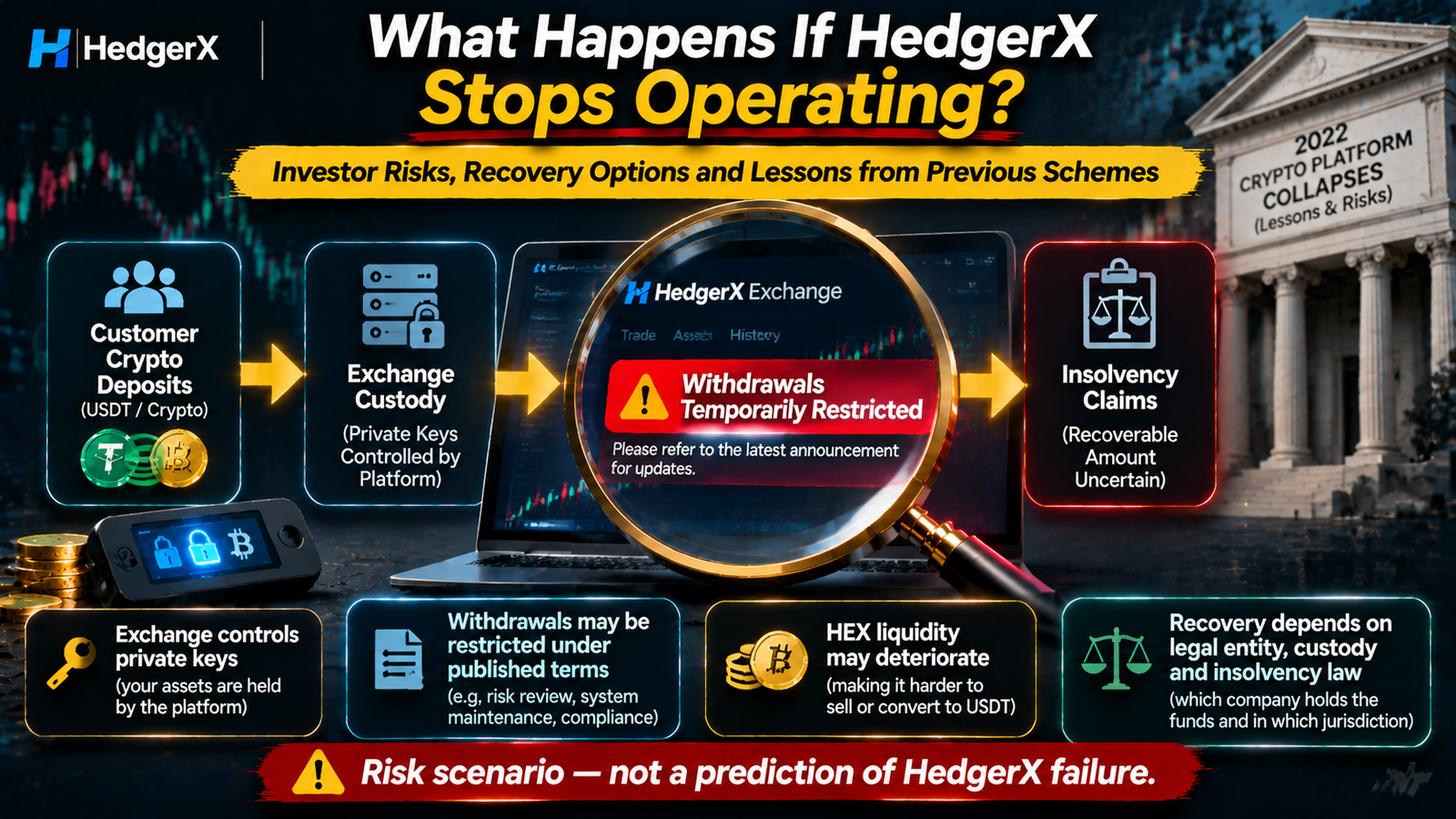
More importantly, its account security section states that HedgerX Exchange retains control over the private keys associated with supported cryptocurrencies held in exchange accounts.
It explicitly states that customers do not have the right to access, control or use those private keys.
This means exchange-account users do not independently control the private keys associated with their exchange balances.
That arrangement is common among centralised cryptocurrency exchanges, but it creates an important counterparty risk.
If the exchange experiences serious operational or financial difficulties, customers may be unable to access their assets even if the corresponding cryptocurrency remains visible on the blockchain.
Participants should distinguish between holding cryptocurrency in a self-custody wallet and holding an account balance with a third-party exchange.
These are fundamentally different arrangements.
2. What happens if HedgerX suspends withdrawals?
HedgerX’s own withdrawal terms provide for circumstances in which withdrawals can be delayed, restricted or suspended.
The published conditions include:
- Account verification and KYC requirements.
- Suspicious transactions and unusual account activity.
- Compliance investigations.
- System maintenance.
- Blockchain network disruptions.
- Changes to withdrawal limits.
- Manual risk-control reviews.
The terms also reserve the platform’s right to modify, suspend or terminate all or part of its withdrawal services.
This does not establish that HedgerX has suspended withdrawals or intends to do so.
However, it demonstrates that participants should not assume uninterrupted access to their cryptocurrency.
The distinction becomes particularly important if a participant has accumulated substantial benefits but cannot transfer those assets out of the platform.
An account balance displayed on a website is not necessarily equivalent to cryptocurrency that a customer can immediately access through an independently controlled wallet.
3. What if the company becomes insolvent?
This is potentially the most serious scenario.
If a company becomes insolvent, its liabilities and assets may need to be examined through formal insolvency proceedings.
Customers may have claims against the relevant legal entity, but the outcome depends on several factors:
- Which company received the deposits?
- Which company legally owes the participant money?
- Where are the cryptocurrency assets held?
- Are customer assets segregated?
- Were customer assets transferred, lent or otherwise used?
- What does the applicable insolvency law provide?
- Are there sufficient assets to meet creditor claims?
HedgerX’s exchange terms identify HedgerX Exchange Malaysia Sdn. Bhd. as the contractual operator of HedgerX.my.
However, that does not automatically establish that the same entity is legally responsible for every Hedger AI or Hedger Pay participation balance.
Participants should establish the exact contractual relationship for each programme.
Another important issue is the distinction between exchange balances and investment-programme benefits.
If the platform operates through multiple legal entities, a customer may need to establish which entity owes the relevant obligation.
This can complicate recovery if the companies have different assets, liabilities and contractual responsibilities.
4. What happened to customers of other failed cryptocurrency businesses?
The collapse of several cryptocurrency businesses demonstrates why custody and corporate transparency matter.
The failure of FTX in November 2022 is one of the most prominent examples.
Customers experienced suspended withdrawals, and the subsequent bankruptcy proceedings revealed substantial financial and operational problems.
The case demonstrated that customers can face serious difficulties when a centralised platform controls their cryptocurrency assets and the company fails.
The US Securities and Exchange Commission has also warned that customers depositing cryptocurrency with certain service providers may not retain the same legal ownership rights they assume they have.
In its investor alert on crypto asset securities, the SEC explains that customers may find themselves standing behind other creditors if a company fails.
The SEC also warns that proof-of-reserves reports do not necessarily disclose a company’s complete liabilities or establish whether customers can recover their assets following insolvency.
These are important lessons for anyone considering depositing cryptocurrency with a centralised exchange or investment platform.
The point is not that HedgerX will necessarily experience the same outcome as FTX.
It is that investors should understand the risks before relying on a platform to safeguard their assets.
5. What happens to HEX if HedgerX stops operating?
HEX introduces another potential recovery concern.
HedgerX describes HEX as the utility token connecting its exchange, Hedger AI and Hedger Pay ecosystem.
If HedgerX stopped operating, the token could face several challenges.
Loss of ecosystem utility: If the applications supporting HEX cease operating, some of its intended uses may disappear.
Reduced liquidity: If exchange trading activity declines or listings are discontinued, participants may find it harder to sell HEX.
Price deterioration: Reduced demand and market confidence could place downward pressure on the token’s market value.
Technical uncertainty: If development and maintenance stop, users may face difficulties obtaining reliable support for the token and related applications.
Unfulfilled roadmap objectives: Planned applications and ecosystem services may never become operational.
Even if HEX remains technically transferable on BNB Smart Chain, that does not guarantee that an active market will exist or that holders can sell their tokens at a reasonable price.
A cryptocurrency can continue to exist on a blockchain while losing most of its commercial utility and market value.
6. Can participants recover their money?
There is no universal recovery mechanism for cryptocurrency losses.
The appropriate steps depend on how the money was transferred, which legal entities were involved and whether there is evidence of wrongdoing or contractual breach.
Potential avenues include:
Contacting the platform: Submit a formal written request for account statements, withdrawal records and confirmation of outstanding balances.
Preserving transaction evidence: Save wallet addresses, transaction IDs, deposit confirmations, screenshots, programme agreements and correspondence.
Identifying the legal entity: Establish which company accepted the money and which entity is contractually responsible.
Reporting suspected fraud: If there is evidence of deception or fraudulent activity, report it to the relevant financial regulator and law-enforcement authorities.
Seeking legal advice: A lawyer familiar with cryptocurrency disputes and insolvency proceedings can assess possible civil claims and recovery options.
For participants in Thailand, the Securities and Exchange Commission provides an investor complaint centre and guidance on checking licensed digital asset businesses.
The SEC can be contacted through its official channels for information about reporting suspected investment-related misconduct.
For Malaysian participants, the relevant authorities and legal procedures may differ depending on the entity involved and the nature of the transaction.
Importantly, reporting a cryptocurrency loss does not guarantee that funds will be recovered.
Blockchain transfers are generally irreversible, and assets may be difficult to trace or recover once moved through multiple wallets or exchanges.
7. Warning signs that investors should not ignore
Participants should pay attention to developments that could indicate increasing financial or operational difficulties.
Examples include:
- Repeated withdrawal delays without clear explanations.
- Sudden changes to withdrawal conditions.
- New requirements to deposit additional money before releasing existing funds.
- Requests to recruit new participants to qualify for withdrawals.
- Unexplained reductions in account balances.
- Disappearing management representatives.
- Unannounced changes to programme terms.
- Inconsistent explanations about the source of participant benefits.
- Unverified claims that all assets are fully backed.
One warning sign does not establish that a company is insolvent or committing fraud.
However, several warning signs occurring together should prompt participants to reassess their exposure and seek independent advice.
In particular, never assume that paying an additional tax, unlocking fee or verification deposit to an unknown party will guarantee the release of existing cryptocurrency.
Such demands can be part of recovery scams targeting people who have already lost money.
8. Questions HedgerX should answer before participants commit money
For a platform combining cryptocurrency exchange services, AI trading and investment-related participation, several disclosures would help investors understand their recovery position.
- Which legal entity holds Hedger AI and Hedger Pay participant liabilities?
- Are participant assets held separately from company operating funds?
- Are customer cryptocurrency balances independently reconciled?
- Are complete financial statements independently audited?
- What happens to outstanding participant benefits if the operating company becomes insolvent?
- Are participants treated as secured creditors, unsecured creditors or beneficiaries of segregated assets under the applicable legal arrangements?
- Does HEX have sufficient independent liquidity outside the HedgerX ecosystem?
- Is there a documented contingency plan for platform closure?
These questions concern fundamental investor protection, not merely technical product features.
Conclusion: Understand the exit before considering the entry
HedgerX’s official exchange terms disclose that it controls the private keys associated with customer exchange accounts and reserves certain rights to restrict or suspend withdrawals.
These are important contractual disclosures for anyone considering holding cryptocurrency on the platform.
The wider investment ecosystem introduces additional questions concerning the legal entities responsible for Hedger AI and Hedger Pay balances, the financial position of the operators and the liquidity of HEX.
The failure of previous cryptocurrency businesses demonstrates that customers can face substantial recovery difficulties when a centralised platform becomes insolvent or stops processing withdrawals.
There is no evidence presented here that HedgerX is about to collapse. The purpose of this investigation is to examine risks that investors should understand before committing funds.
Ultimately, the most important question is not simply how much a platform says participants can earn.
It is whether participants can independently access their assets and what legal protections exist if the business stops operating.
Before investing, understand the exit strategy. Because recovering cryptocurrency after a platform failure can be considerably harder than depositing it.