
Cryptocurrency investment platforms frequently introduce their own digital tokens to support trading activities, reward participants and encourage the growth of their ecosystems.
These tokens can have genuine utility. They can also introduce additional financial risks, particularly when investors receive part of their advertised benefits in a cryptocurrency whose market value and liquidity may fluctuate.
HedgerX has introduced its own digital asset, known as HEX, as part of its broader cryptocurrency and AI trading ecosystem.
The token is described as the utility token connecting HedgerX’s exchange, Hedger AI, Hedger Pay and other planned applications.
But what is HEX actually worth? How many tokens will exist? Who receives the largest allocations? What is the proposed token-burning mechanism? And can investors independently verify the token’s security and market liquidity?
This investigation examines the published tokenomics and identifies important questions that prospective participants should consider.
1. What is the HedgerX HEX token?
According to the HedgerX HEX Whitepaper Version 1.0, published in July 2026, HEX is the core utility token of the HedgerX ecosystem.
The token operates on BNB Smart Chain using the BEP-20 standard and has 18 decimal places.
HedgerX describes several intended uses for HEX:
- Trading fee discounts.
- VIP trading benefits.
- Payments within ecosystem applications.
- Hedger AI and Hedger Pay participation.
- Referral and community incentives.
- Launchpad and Launchpool access.
- Future on-chain applications.
The company also describes HEX as a mechanism for connecting the different products within its ecosystem.
An important distinction: this HedgerX token is unrelated to the similarly named HEX cryptocurrency operating on Ethereum.
Investors should always verify the correct network and contract address before purchasing or transferring a token.
2. What is the maximum supply of HEX?
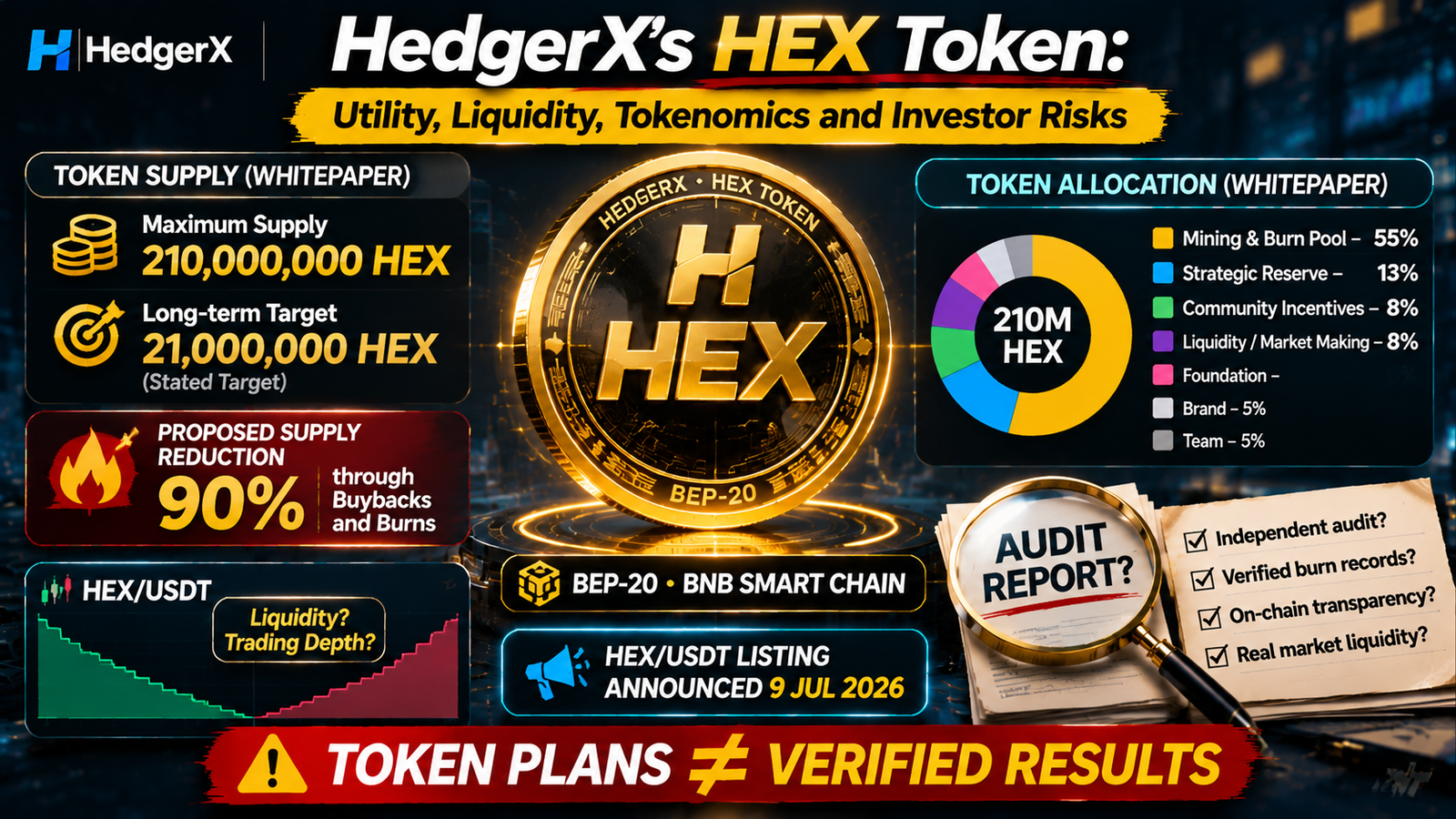
The published whitepaper specifies a maximum supply of 210 million HEX.
It also introduces a longer-term supply target of 21 million tokens through proposed buybacks and burns.
<text color=”secondary” size=”xs”>Published token supply figures</text>
| Token metric | Published figure |
|---|---|
| Maximum supply | 210,000,000 HEX |
| Long-term target | 21,000,000 HEX |
| Proposed supply reduction | 90% |
| Token standard | BEP-20 |
| Blockchain | BNB Smart Chain |
| Decimal places | 18 |
The proposed reduction from 210 million to 21 million represents a substantial change in the token’s intended supply.
However, there is an important distinction between a maximum supply, a circulating supply and a future supply target.
The 21 million figure is a target, not evidence that 189 million tokens have already been removed from circulation.
To achieve that target, approximately 189 million HEX would need to be bought back and burned.
The whitepaper does not provide a fixed completion date for this objective.
3. How are the 210 million tokens allocated?
The whitepaper publishes the following token allocation structure:
| Allocation | Percentage | HEX |
|---|---|---|
| Mining and Burn Pool | 55% | 115.5 million |
| Strategic Ecosystem Reserve | 13% | 27.3 million |
| Community and Trading Incentives | 8% | 16.8 million |
| Liquidity and Market Making | 8% | 16.8 million |
| Foundation and Protection Fund | 6% | 12.6 million |
| Brand Development | 5% | 10.5 million |
| Team and Core Contributors | 5% | 10.5 million |
| Total | 100% | 210 million |
The largest allocation is the Mining and Burn Pool, which receives 55% of the maximum supply.
This pool is intended to support trading incentives, ecosystem rewards, liquidity mining and token burns.
The team allocation represents 5%, or 10.5 million HEX.
However, the whitepaper does not provide a complete vesting or token-release schedule for these allocations.
This is an important transparency issue.
Without a published schedule, investors cannot easily determine when tokens allocated to the team, reserves and other categories may enter circulation.
Large future token releases could affect supply, selling pressure and market prices.
4. How does the proposed HEX burning mechanism work?
HedgerX describes a long-term strategy of reducing token supply through buybacks and burns.
The whitepaper identifies seven potential sources of token burns:
- Trading-fee buybacks: Using revenue from exchange trading services to purchase HEX and permanently remove it from circulation.
- Application consumption: Burning tokens used for certain ecosystem payments and services.
- Launchpad and Launchpool: Using HEX for participation, allocations and related ecosystem access.
- Ecosystem onboarding: Using tokens for partner, developer and merchant services.
- Token payments: Removing tokens used for eligible ecosystem fees.
- Research and grants: Supporting ecosystem development through token-based allocations and consumption.
- Future on-chain gas: Burning HEX used for transaction fees on a planned HedgerX blockchain or Layer 2 network.
The concept is straightforward: if tokens are permanently removed from circulation while demand remains stable or increases, the available supply may decrease.
However, a proposed burn mechanism does not automatically create value.
The actual impact depends on how many tokens are burned, how frequently burns occur, whether demand exists and whether new token releases offset the reductions.
Investors should look for publicly verifiable burn transactions rather than relying only on announcements.
5. Where can HEX be used?
HedgerX describes several applications for its token.
Hedger AI
HEX is connected to the Hedger AI participation and benefit-distribution structure. The programme describes receiving half of the daily benefits in HEX.
Hedger Pay
The whitepaper describes a 10% discount on eligible packages purchased using HEX, with the relevant tokens burned.
It also describes distributing half of the daily base benefits in HEX.
HedgerX Exchange
HEX is intended to support trading fee discounts, VIP benefits and trading-related incentives.
Future ecosystem applications
The whitepaper describes planned applications involving Launchpad access, developer incentives, governance and blockchain infrastructure.
These different applications could create demand for HEX if they become active and attract genuine users.
However, investors should distinguish between features currently available and future development plans.
A proposed blockchain or governance mechanism should not be treated as an operational product until it can be independently demonstrated.
6. Is HEX actually traded on an exchange?
HedgerX published an announcement on 9 July 2026 confirming the scheduled opening of HEX deposits, withdrawals and HEX/USDT spot trading.
The announcement identifies the trading pair as HEX/USDT and provides the exchange trading page.
This establishes that HedgerX publicly announced its own listing.
However, a listing announcement is not the same as proof of substantial liquidity.
Investors should examine actual market information, including:
- Daily trading volume.
- Available buy and sell orders.
- Bid-ask spreads.
- Order-book depth.
- Number of independent trading venues.
- Withdrawal availability.
- The difference between quoted prices and executable prices.
A token can have a displayed market price but still have insufficient liquidity for participants to sell significant quantities without affecting the price.
This is especially important when an investment programme distributes benefits partly in its own ecosystem token.
7. Has the HEX smart contract been independently audited?
Smart-contract security is another important area.
The independent HedgerX information guide, HedgerXAI.com, examined the July 2026 whitepaper and the company’s roadmap.
Its October 2026 review reported that the roadmap had scheduled a HEX smart-contract audit for August to September 2026, but it had not located a published audit report at the time of its review.
The guide also noted that the whitepaper described audits, multi-signature controls and treasury security arrangements as measures to be established.
An independent smart-contract audit should identify:
- The auditor’s name.
- The exact contract address examined.
- The audit date.
- The scope of the review.
- Security vulnerabilities identified.
- Whether identified issues were resolved.
- Whether the deployed contract matches the audited version.
An audit is not a guarantee against fraud, market losses or poor business management. However, it can provide important information about technical security.
Prospective HEX holders should request the complete audit report and verify that it refers to the actual deployed contract.
8. The risk of receiving investment benefits in HEX
One of the most important considerations for HedgerX participants is that part of the advertised benefits is distributed in HEX rather than entirely in USDT.
This introduces additional uncertainty.
For example, suppose a participant is credited with 10 USDT equivalent in total benefits:
- 5 USDT is distributed in USDT.
- 5 USDT equivalent is distributed in HEX.
The USDT portion is denominated in a stablecoin, although it still carries cryptocurrency and counterparty risks.
The HEX portion depends on the token’s market price and the ability to sell it.
If HEX falls by 50% after distribution, the participant’s 5 USDT-equivalent token allocation could be worth approximately 2.50 USDT at the new market price.
This is a hypothetical illustration, not a prediction of HEX’s price.
It demonstrates why an internally calculated benefit value should not be confused with realised cash value.
Participants should assess the two components separately.
9. Important unanswered questions about HEX
The published whitepaper provides useful information about the intended tokenomics, but several important details deserve further disclosure.
- What is the actual circulating supply?
- How many HEX tokens are held by the team and related entities?
- What is the vesting schedule for the 10.5 million team allocation?
- How much liquidity is independently available?
- What percentage of trading volume is generated by independent external users?
- How many tokens have actually been burned?
- Where are the public buyback and burn transaction records?
- Has an independent smart-contract audit been completed?
- Who controls the token treasury and reserve wallets?
These questions are important because a token’s economic value depends on more than its published utility.
Supply distribution, market liquidity, ownership concentration, security and genuine demand all matter.
Conclusion: A tokenomics document is only the beginning
HedgerX has published a HEX whitepaper describing a 210 million maximum supply, a 21 million long-term target, seven proposed burn mechanisms and several ecosystem applications.
The document provides a starting point for understanding the company’s intended token model.
However, the distinction between published plans and demonstrated results remains essential.
The actual circulating supply, token-release schedule, independently verified burns, market liquidity and smart-contract audit status should all be supported by publicly accessible evidence.
For participants receiving HEX as part of an investment-related benefit programme, these details are particularly important.
A token credited to an account is not necessarily equivalent to cash that can be withdrawn or sold at its displayed value.
Until the outstanding questions are supported by independently verifiable information, investors should treat HEX as a speculative digital asset with potentially substantial liquidity, market and technical risks.