Sunshine Empire was not simply a company selling lifestyle products. Its business model combined multi-level marketing (MLM), package purchases, internal reward points and a monthly payment arrangement known as Consumer Rebate Privilege (CRP).
The structure attracted thousands of participants, many of whom were interested in the financial benefits associated with purchasing increasingly expensive packages.
But how did the compensation plan actually work? What did participants receive in exchange for their money? And, most importantly, where did the money used to fund the monthly payments come from?
The Singapore High Court examined these questions in detail in Phang Wah and others v Public Prosecutor [2011] SGHC 251. Its findings provide an important account of how Sunshine Empire operated and why its business model was ultimately found to be unsustainable and fraudulent.
1. How people joined Sunshine Empire
According to the High Court judgment, members of the public joined Sunshine Empire by registering with the company and being sponsored by an existing participant.
New participants first became Merchant Affiliates by paying a registration fee of 25 e-Points, equivalent to S$40.
They could then purchase lifestyle packages under the company’s compensation structure.
From July 2007, Merchant Affiliates were also provided with a starter kit containing the company’s business model, compensation plan and policy guide, together with mentoring from Sunshine Empire leaders.
The sponsorship requirement was an important part of the MLM structure because existing participants could benefit when they introduced new people who subsequently purchased packages.
2. The lifestyle packages
Sunshine Empire offered two broad categories of packages:
- Merchant packages: Bronze Merchant and Silver Merchant.
- Prime packages: Bronze Prime, Silver Prime and Gold Prime.
The Prime packages were more expensive, offered more EM-Call talk time and, importantly, provided eligibility for Consumer Rebate Privilege payments.
This distinction was central to the business model.
Participants purchasing Merchant packages could participate in the compensation plan, but only Prime package participants were entitled to CRP.
The Gold Prime package eventually became the most popular option.
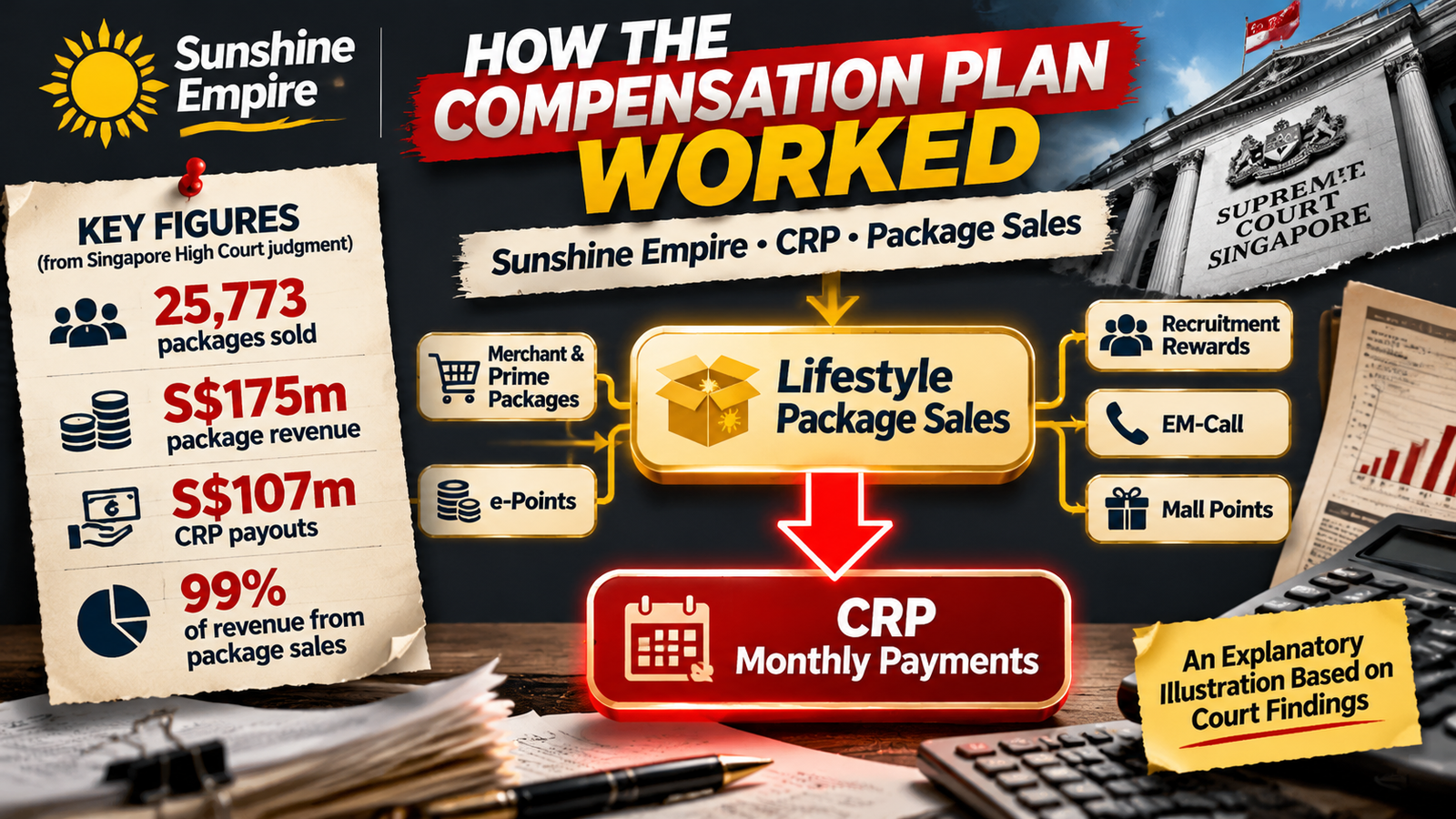
The High Court recorded that 16,784 of the 25,773 packages sold were Gold Prime packages, representing more than 65% of all package purchases examined.
The Gold Prime package cost S$12,000.
The court considered the value of the actual products and services included in the package and concluded that their value represented only a relatively small proportion of the purchase price.
The prospect of receiving higher CRP payments was an important reason participants were attracted to the more expensive package.
3. Understanding the internal reward points
Sunshine Empire’s compensation structure used several types of internal points.
e-Points
These could be exchanged for cash at S$1.60 per point, subject to an administration fee. Participants could also use them to purchase additional packages or transfer them to their e-Mall accounts.
The judgment noted that e-Points could not be purchased directly by participants. They were earned through the compensation plan and CRP arrangements.
Mall points
Mall points were redeemable for products through the company’s e-Mall platform.
Unlike e-Points, mall points could not be converted into cash or transferred between participants.
EM-Call talk time
This was a telecommunications service designed to convert outgoing calls into incoming calls, allowing users with free incoming-call plans to reduce their mobile telephone expenses.
Unused EM-Call talk time purchased under Prime packages expired monthly.
The company also allowed participants to sell products through its e-Mall platform from July 2007.
These components gave Sunshine Empire the appearance of a conventional product-based MLM operation. However, the High Court examined whether their actual commercial value justified the amounts participants were paying.
4. How the compensation plan rewarded recruitment
The compensation plan rewarded participants with e-Points and mall points for purchasing lifestyle packages and sponsoring other people who purchased packages.
Rewards were credited to participants’ internal e-Bank accounts.
Participants could then transfer their points into their e-Mall accounts to purchase products.
This created two incentives within the programme:
First, participants had an incentive to purchase packages themselves.
Second, they had an incentive to introduce additional participants whose purchases could contribute to their compensation.
The distinction matters because a compensation plan can become financially problematic when recruitment and package sales become more important than genuine external demand for the products being sold.
In Sunshine Empire’s case, the court examined the relationship between package sales, participant incentives and the monthly CRP payments.
5. What was Consumer Rebate Privilege?
CRP was arguably the most important feature of Sunshine Empire’s business model.
Prime package participants received monthly CRP payments. The arrangement was initially referred to as profit-sharing between August and December 2006 before adopting the CRP name in January 2007.
Phang Wah and Jackie Hoo maintained that CRP was discretionary and non-guaranteed. Sunshine Empire was not legally required to distribute a particular amount or continue making payments.
However, the High Court considered more than the contractual wording.
The court examined the company’s consistent history of making payments and the effect those payments had on participants’ purchasing decisions.
Over approximately 15 months, the company maintained a high level of CRP payments, producing returns of approximately 160%.
The court concluded that these historical payments had become a major attraction of the lifestyle packages.
In other words, even though the payments were technically discretionary, participants were influenced by the established practice of receiving them.
6. Where did the CRP money actually come from?
This was one of the most significant findings in the entire case.
The High Court recorded that approximately 99% of Sunshine Empire’s revenue came from lifestyle package sales.
Between August 2006 and October 2007, the company sold 25,773 packages, generating approximately S$175 million in revenue.
During the same period, total CRP payouts amounted to approximately S$107 million.
The court found that the high CRP payments were funded by sales of new packages rather than a credible alternative source of commercial revenue.
Participants were not properly informed that package sales were funding the CRP payments. Instead, references to e-Mall consumption, worldwide performance and global turnover created the impression that other commercial activities were supporting the distributions.
The court found that the source of the CRP payments had been deliberately obscured.
This was a central part of its conclusion that the business had been operated for a fraudulent purpose.
7. What happened when the numbers stopped adding up?
The financial imbalance became increasingly apparent as the business expanded.
The judgment records that Sunshine Empire received approximately S$21 million in October 2007 but paid out more than S$25 million.
The court also found that the company’s CRP payouts repeatedly exceeded the claimed limit of 50% of the previous month’s revenue from February 2007.
With no credible alternative revenue source capable of sustaining the payout structure, the court concluded that the business was clearly unsustainable.
The Commercial Affairs Department raided Sunshine Empire’s premises on 13 November 2007, bringing its operations to a halt.
8. What investors can learn from the Sunshine Empire case
The Sunshine Empire case provides several practical lessons when evaluating modern MLM and cryptocurrency investment programmes.
Look beyond the advertised products. A company may sell real products and services, but that does not automatically mean its compensation structure is financially sustainable.
Identify the source of distributions. Monthly benefits should be supported by independently verifiable commercial revenue rather than simply relying on additional package purchases.
Examine the recruitment incentives. Understand whether participants are rewarded primarily for genuine product sales or for bringing in new paying members.
Check the actual value of packages. Compare the purchase price with the reasonable commercial value of the products and services included.
Do not confuse historical payouts with profitability. A programme’s ability to pay participants for several months does not demonstrate that it has a sustainable source of income.
These principles remain relevant when examining modern platforms advertising AI-assisted trading, cryptocurrency rewards and daily participation benefits.
Conclusion
Sunshine Empire’s compensation plan combined lifestyle packages, internal reward points, recruitment incentives and monthly Consumer Rebate Privilege payments.
The Singapore High Court found that the business relied overwhelmingly on package sales to fund CRP payments, while participants were not properly informed about the source of those distributions.
The court ultimately upheld the convictions of Phang Wah and Jackie Hoo Choon Cheat for carrying on the business for a fraudulent purpose.
For anyone investigating modern investment programmes, the lesson is straightforward: understanding where the money comes from is more important than understanding how attractive the advertised compensation plan appears.
The original Singapore High Court judgment remains publicly available and provides the primary evidence behind this historical account.
Sources and outbound links
- Singapore High Court — Phang Wah and others v Public Prosecutor [2011] SGHC 251 — primary source, particularly paragraphs 7–12 and 34–43.
- Bank Negara Malaysia — Sunshine Empire Sdn Bhd pleads guilty to illegal deposit taking — regulatory background.
- The Straits Times — Guilty as charged: Sunshine Empire duped investors of millions — supplementary historical reporting.